Gerhard Vosloo wins Meiring Naude Award for Deep Learning project
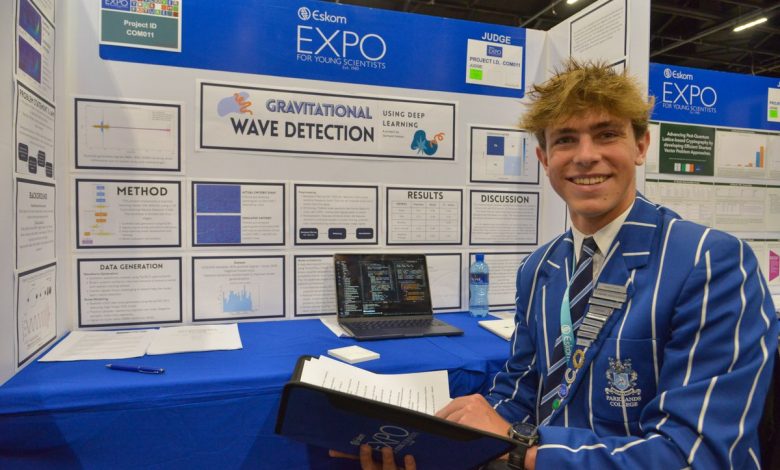
The Department of Basic Education is delighted to share the wonderful news of Gerhard Vosloo from Parklands College in Cape Town, who has been honoured with the prestigious Meiring Naude Award. This recognition celebrates his outstanding project titled “Gravitation wave detection using Deep Learning,” showcasing the incredible talent and innovation present among our young South African scientists at the Eskom Expo for Young Scientists.
Key details
- Award recipient: Gerhard Vosloo
- Award name: Meiring Naude Award
- Institution: Parklands College
- Location: Cape Town
- Project title: “Gravitation wave detection using Deep Learning”
- Event context: The award was presented as part of the Eskom Expo for Young Scientists International Science Fair (ISF), a national platform for young scientists.
- Department’s involvement: The South African Department of Basic Education (DBE) acknowledges and promotes such achievements, highlighting the importance of science, technology, engineering, and mathematics (STEM) education.
Departmental activities supporting young scientists
The Department of Basic Education (DBE) is incredibly proud to see learners like Gerhard Vosloo excel in scientific innovation. His achievement at the Eskom Expo for Young Scientists underscores the vital importance of fostering a love for science and technology from an early age. The DBE actively supports and encourages participation in such national initiatives, which provide invaluable platforms for young minds to explore, experiment, and present their research. These expos are crucial for nurturing future scientists, engineers, and innovators who will contribute significantly to South Africa’s development and global scientific advancement. We believe that by investing in quality STEM education and providing opportunities for practical application, we are equipping our learners with the critical thinking skills and knowledge needed to tackle complex challenges and drive progress in various fields. For more information on our efforts and educational programmes, please visit our official website at www.education.gov.za. You can also discover more news and activities related to schools across the country by visiting SchoolClick.
Frequently asked questions
-
What is the Meiring Naude award?
The Meiring Naude Award is a prestigious recognition given to a learner or team at the Eskom Expo for Young Scientists for an exceptional and innovative science project that demonstrates outstanding scientific inquiry and impact.
-
Who is Gerhard Vosloo and what was his project about?
Gerhard Vosloo is a learner from Parklands College in Cape Town who won the Meiring Naude Award. His project, “Gravitation wave detection using Deep Learning,” focused on using advanced artificial intelligence techniques to identify gravitational waves, which are ripples in space-time caused by massive cosmic events.
-
What is the Eskom Expo for Young Scientists?
The Eskom Expo for Young Scientists is South Africa’s premier science fair for school learners. It provides a platform for learners to present their science, engineering, and technology projects to judges and the public, encouraging scientific literacy and innovation.
-
How can learners participate in the Eskom Expo?
Learners from Grade 4 to Grade 12 can participate. They typically develop a science project under the guidance of a teacher or mentor, and then register through their school or a regional expo office. More details are available on the Eskom Expo official website.
-
Why does the Department of Basic Education promote events like this?
The Department of Basic Education (DBE) promotes such events to foster interest in STEM subjects, develop critical thinking and problem-solving skills, and identify and nurture young talent. These initiatives are vital for building a future generation of skilled professionals and innovators for South Africa.
-
Are there age limits for participation in the Eskom Expo?
Yes, the Eskom Expo for Young Scientists is open to learners from Grade 4 up to Grade 12, ensuring that a wide range of young scientists can showcase their work and develop their skills.
-
What kind of support is available for young scientists in South Africa?
Beyond platforms like the Eskom Expo, the DBE supports science education through curriculum development, teacher training, and promoting science clubs in schools. Various non-governmental organisations and universities also offer workshops, competitions, and mentorship programmes.
-
Where can I find more information about science education and opportunities?
You can visit the official Department of Basic Education website at www.education.gov.za for information on our educational programmes. Details about the Eskom Expo can be found on their dedicated website, and local district education offices can also provide guidance on regional opportunities.